Whome vs. Whom: Decoding the Right Spelling

By Shumaila Saeed || Published on December 31, 2023
"Whome" is an incorrect spelling while "Whom," correctly spelled, is a pronoun used in formal contexts or writing, referring to the object of a verb or preposition.
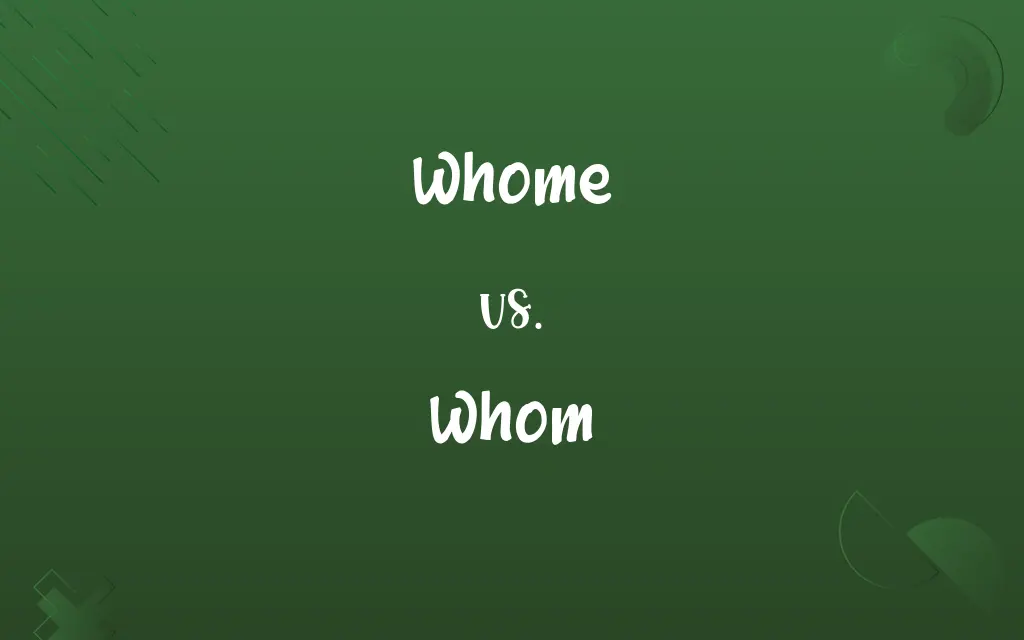
Which is correct: Whome or Whom
How to spell Whom?
Whome is Incorrect

Whom is Correct
How to remember correct spelling of Whom?
Create a mnemonic: "When in doubt, choose the shorter route; 'Whom' not 'Whome.'"

Shumaila Saeed
Dec 31, 2023
Recall "Who" and "Him": combine them to remember "Whom" as the object form.
Shumaila Saeed
Dec 31, 2023
Associate "Whom" with formal writing, where brevity and correctness are key.
Shumaila Saeed
Dec 31, 2023
Note that "Whom" has one less letter than "Whome," aligning with its more formal use.
Shumaila Saeed
Dec 31, 2023
Practice using "Whom" in questions where the answer would be "him" or "her."
Shumaila Saeed
Dec 31, 2023
Whom Definitions
In formal writing, "whom" replaces "who" when referring to the object of a verb or preposition.
The manager, whom I met yesterday, was very kind.
Shumaila Saeed
Dec 13, 2023
Whom is used after a preposition in formal statements.
To whom should I address this letter?
Shumaila Saeed
Dec 13, 2023
Whom is used in questions to ask about the object of a verb.
Whom did you call?
Shumaila Saeed
Dec 13, 2023
Whom is used in indirect questions, often after verbs like ask or tell.
I wonder whom she will invite to the party.
Shumaila Saeed
Dec 13, 2023
(interrogative) What person or people; which person or people.
Shumaila Saeed
Oct 19, 2023
As the object of a preposition.
To whom are you referring?
With whom were you talking?
Shumaila Saeed
Oct 19, 2023
(relative) Used to refer to a previously mentioned person or people.
That is the woman whom I spoke to earlier. (defining)
Mr Smith, whom we all know well, will be giving the speech. (non-defining)
He's a person with whom I work. (defining)
We have ten employees, half of whom are carpenters. (non-defining)
Shumaila Saeed
Oct 19, 2023
The person(s) whom; whomever.
To whom it may concern, all business of John Smith Ltd. has now been transferred to Floggitt & Runne.
Shumaila Saeed
Oct 19, 2023
The objective case of who. See Who.
And every grass that groweth upon rootShe shall eke know, and whom it will do boot.
Shumaila Saeed
Oct 19, 2023
Whom is used in a relative clause, especially in formal contexts.
The author, whom many admire, is speaking tonight.
Shumaila Saeed
Dec 13, 2023
Repeatedly Asked Queries
Why do people often confuse "Whom" with "Whome"?
The confusion might come from the similarity in sound and the less frequent use of "Whom" in everyday speech.
Shumaila Saeed
Dec 31, 2023
Whome or Whom?
The correct spelling is "Whom." "Whome" is an incorrect form.
Shumaila Saeed
Dec 31, 2023
What part of speech is "Whom"?
"Whom" is a pronoun used to refer to the object of a verb or preposition.
Shumaila Saeed
Dec 31, 2023
What is the origin of the word "Whom"?
"Whom" originates from Old English "hwām" or "hwǣm," which is the dative case of "who."
Shumaila Saeed
Dec 31, 2023
Can "Whom" be used interchangeably with "Who"?
No, "Whom" and "Who" are not interchangeable. "Who" is a subject pronoun, while "Whom" is an object pronoun.
Shumaila Saeed
Dec 31, 2023
Is "Whom" still relevant in modern English?
Yes, "Whom" is still relevant, especially in formal writing and speech.
Shumaila Saeed
Dec 31, 2023
How can one decide between "Who" and "Whom"?
If the pronoun is the object of a verb or preposition, use "Whom." If it's the subject, use "Who."
Shumaila Saeed
Dec 31, 2023
How is "Whom" used in a sentence?
"Whom" is used in questions and statements to refer to the object, as in, "Whom did you see?"
Shumaila Saeed
Dec 31, 2023
What are common mistakes made with "Whom"?
A common mistake is using "whom" as a subject or using "who" in its place as an object.
Shumaila Saeed
Dec 31, 2023
What does "Whom" indicate in a sentence?
"Whom" indicates the person that is the recipient or object of an action.
Shumaila Saeed
Dec 31, 2023
Is "Whom" often used in everyday conversation?
"Whom" is less common in casual speech but is still used in formal contexts.
Shumaila Saeed
Dec 31, 2023
Does the use of "Whom" differ in British and American English?
The usage is similar in both, but "Whom" might be slightly more prevalent in formal British English.
Shumaila Saeed
Dec 31, 2023
How can one improve in correctly using "Whom"?
Practice by identifying the object in sentences and replacing it with "whom" where applicable.
Shumaila Saeed
Dec 31, 2023
Does "Whom" have different meanings in different contexts?
No, "Whom" consistently functions as an object pronoun across different contexts.
Shumaila Saeed
Dec 31, 2023
Why is "Whom" considered formal?
"Whom" is considered formal due to its specific grammatical role and less frequent use in everyday language.
Shumaila Saeed
Dec 31, 2023
Share this page
Link for your blog / website
HTML
Link to share via messenger

About Author

Written by
Shumaila SaeedShumaila Saeed, an expert content creator with 6 years of experience, specializes in distilling complex topics into easily digestible comparisons, shining a light on the nuances that both inform and educate readers with clarity and accuracy.










 Shumaila Saeed
 Dua Fatima